


Foreword: I started writing this piece a month ago. At the time, I thought I was making a contrarian argument: that the debate over the role and impact of AI in schools had crossed from policy into politics. That claim now looks embarrassingly mainstream. The Economist published a cover leader declaring the backlash was “only getting started.” TIME documented a coordinated day of protest in more than 125 communities. Matt Yglesias supplied the cleanest marker of the turn: in February he was “not convinced” the backlash was real; by July he was writing that the data-center backlash wasn’t just NIMBYism.
Polling released during the past three weeks has strengthened the thesis. Emerson found national opposition to nearby data centers jump from 42 percent in December to 63 percent in July. Gallup found the share of Americans who think AI does more harm than good rise from 31 percent to 39 percent, with the largest swing among adults under 30.
The post I wrote is already late. I’ve opted to publish it without much further revision.
+++
TL;DR
Over the past several months superintendents from the country’s largest school systems have described the same change in the weather of public sentiment. Parents are pushing back against AI. Students are pushing back even harder. As one superintendent told me, “In order to deal with the parent pushback against AI, we’re rewinding two years of work.”
The temptation is to hear that as a setback to AI implementation. It is better understood as a communications and governance crisis. Communities are telling schools that the rules, evidence and consent have not kept pace with adoption, and schools are failing to win confidence in their response to those concerns. The question is no longer whether AI is coming to education. It is whether schools can set the terms before a broad public backlash sets them instead.
+++
Conference panels have a familiar rhythm. Intros and setups that drag on, panelists agreeing with each other, moderators thanking everyone for a rich discussion. I’ve sat through a hundred of these (and I’ve shared my lack of enthusiasm for the format before). Randi Weingarten reminded me what’s possible when you wield the power of a public speech. She also opened my eyes to a storm that’s brewing: growing public outrage over AI. I believe this storm should dominate thinking about school’s strategy as they navigate the next chapter of the Fourth Industrial Revolution.
I was in Baltimore on Jun 3, 2026 for the Education Writers Association national seminar. Weingarten, the president of the American Federation of Teachers, was on an afternoon panel about AI in classrooms, one week after she had released her ten-point plan on AI and schools. I was ready for the usual: guarded optimism and a laundry list of concerns to mitigate, a plug for teacher voice, etc.
That isn’t what happened. Instead, it was the liveliest conversation I’ve ever attended at an education event.
Weingarten opened with a salvo aimed at the Trump administration, which, in my view, has been the plan’s most prominent detractor. The day after Weingarten’s speech, Education Secretary Linda McMahon went on Newsmax and said that schools need to “embrace AI and use it appropriately.” The Education Department’s response also reached back to the AFT’s support for school closures during COVID. Weingarten dismissed this as an unserious objection. There is no guidance, she said.
The union president also put daylight between AFT and its funders. The union announced a $23 million training academy last year with support from Microsoft, OpenAI and Anthropic. Before anyone could raise it, she told the room that AFT had written OpenAI a formal letter demanding a meeting over its defense work (and that they had backed Anthropic when it declined the same business). “It’s not as if we are lockstep with the companies,” she said. The companies provide something the union needs, she went on, which is the operational ability and technical expertise to train teachers so they can advocate for themselves.
The moderator raised one critique of the plan, from the analyst Chad Aldeman, posted the day before: that its two central planks are incompatible, since you cannot redesign school around projects and rebuild foundational knowledge at the same time. Weingarten rejected the premise that we cannot find a middle ground. There’s a difference between a veteran teacher and a brand-new substitute using AI. She voiced concerns about kids offloading their thinking before the muscle exists, and pointed to the plan’s barring of student-facing AI in elementary school. Weingarten argued that the two planks belong together, rather than in tension: “Foundational knowledge is absolutely important. But in order to assess it, they have to apply it.”
One audience member asked why AFT isn’t waiting out this administration for a friendlier one. “Really? Given AI, we’re gonna wait for maybe there’s gonna be another administration in 2028?” Superintendents are already calling, she said, and New York’s state union went a little farther than she did within days of the plan’s release. What school leaders need is “the courage of their convictions”—and she hopes her speech supplies it.
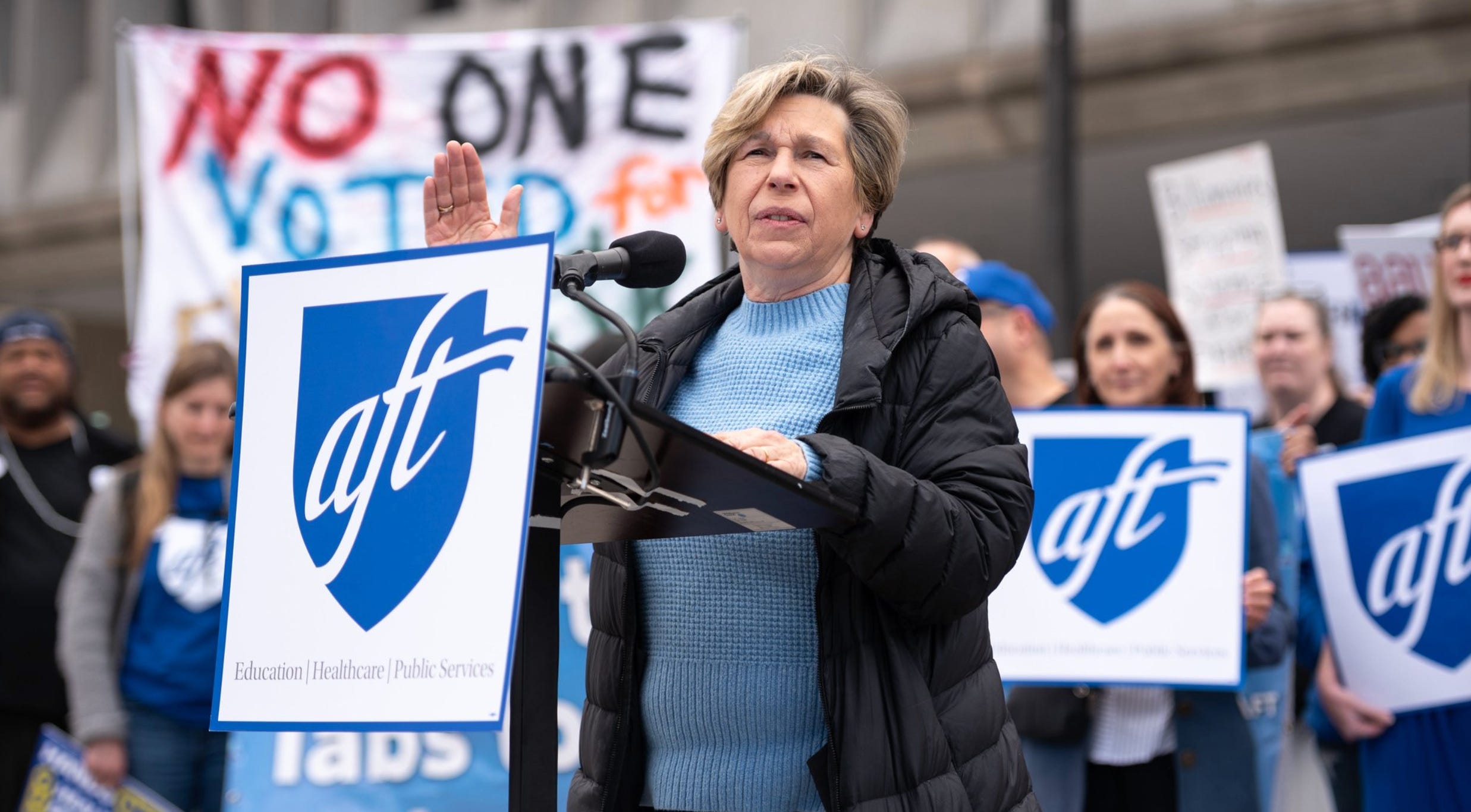
“AI is not a play toy,” Weingarten said. “It fundamentally changes the course of human history.”
Somewhere in that hour it clicked. I was listening to a stump speech, delivered by someone who has run this play before. It was a stump speech for a campaign that doesn’t have a candidate yet.
This is more than a semantic shift. It fundamentally changes what the conversation about AI is going to look and feel like. Gone are the days of policy roundtables, working groups and frameworks in comfortable conference venues. For better or worse, the debate around “AI” is now on a national stage. This is rough-and-tumble, Tier 1 politics. It happened gradually over the past year, and I don’t believe it’s moving back. Schools and education are right in the epicenter.
People don’t like AI.
Last week I wrote about how AI has become one of the most polarizing forces in American life. Let’s dig in.
Half of American adults now tell Pew that AI makes them more concerned than excited; one in ten say the reverse. And just 16% believe AI will have a positive effect on society. When NBC News tested voters’ feelings toward a long list of topics this spring, AI came out at 26% positive to 46% negative. The only things rated lower were the Democratic Party and Iran. Young people, who were supposed to take this all in stride, are actually the angriest cohort in the data. Gallup and Walton found Gen Z anger toward AI jumped nine points in a single year, to 31%. Eight in ten young people say AI will make it harder for them to learn. Quinnipiac: 81% of Gen Z expects AI to shrink their job opportunities, the most pessimistic of any generation polled.
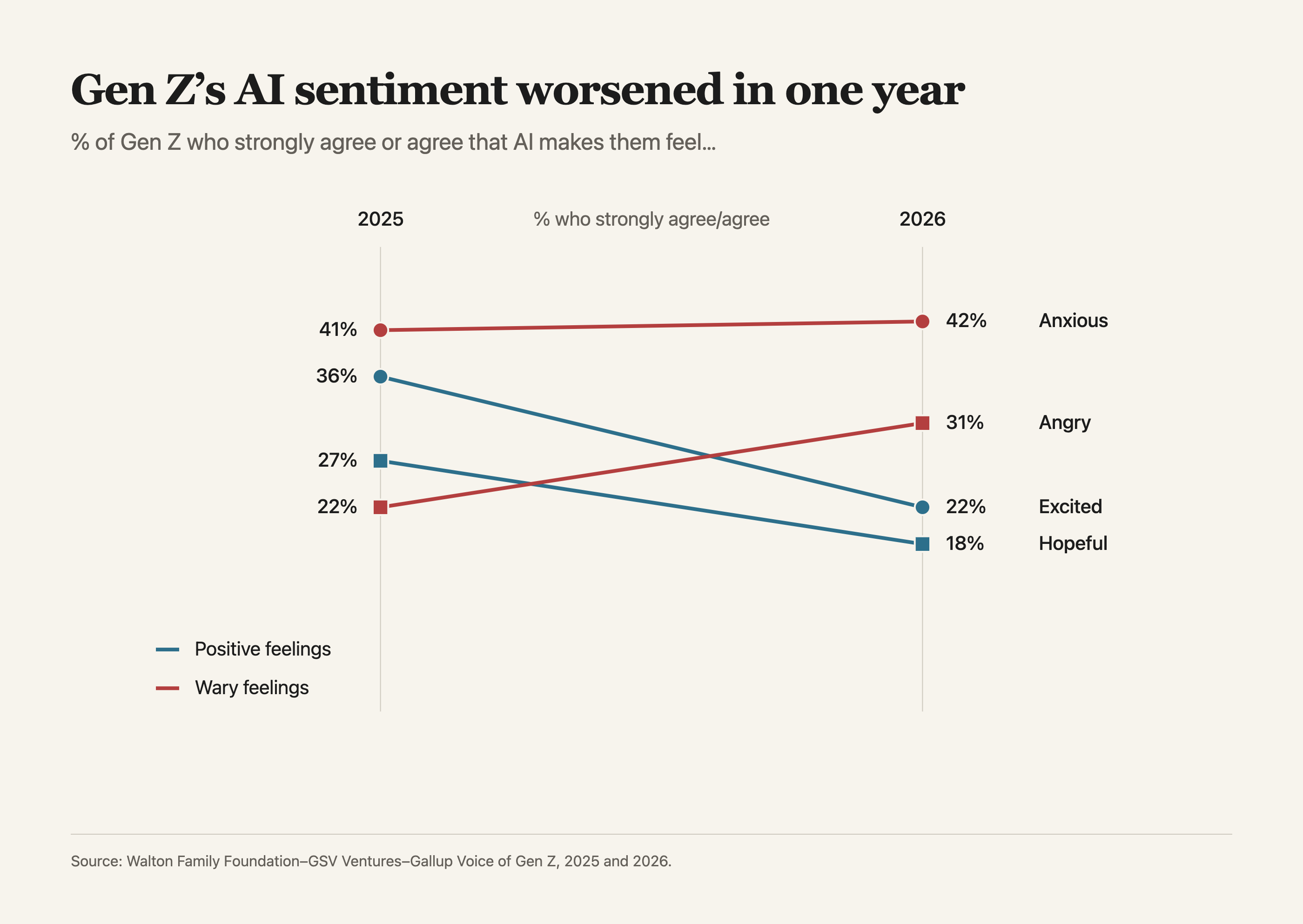
Three new polls out last week suggest the backlash is still growing. Gallup found that the share of Americans who believe AI does more harm than good rose from 31% to 39% in a year—including a jump from 36% to 47% among adults under 30—while Marquette found that 76% of Wisconsin voters believe AI’s costs will outweigh its benefits. But the opposition remains more diffuse than organized: only 5% of those Wisconsin voters named AI as the country’s most important issue, and Pew found that 51% of Americans say neither party reflects their views on AI policy.
Kids’ negative sentiment toward AI was something many of us had sensed, but it came under the spotlight when graduates booed Eric Schmidt and other commencement speakers when they told them AI would shape their world. NPR ran a literal advice piece for commencement speakers: don’t bring up AI.
Data centers are also at the heart of the shift in public sentiment. In July, a POLITICO/Public First poll found that opinion about a data center within three miles of home had flipped in six months. In January, support led opposition 37% to 28%. By July, support had fallen to 24% and opposition had risen to 41%. The movement is still startling.
Other evidence points to the same. A representative University of Houston survey found that 85% of Greater Houston residents use AI while 63% oppose a data center within one mile of their home. Energy demand was the most common concern. Data Center Watch, a project tracker run by 10a Labs, estimates that local opposition blocked or delayed at least 75 projects worth roughly $130 billion in the first quarter of 2026. That’s about as many projects as in all of 20251.
In New York, a Panel for Educational Policy meeting went almost seven hours in April, with over a hundred parents demanding a moratorium on AI in schools. By late June, the city had shelved its own draft AI guidance after 6,500 public comments and a letter from half the City Council. And when Gallup asked Americans in March whether they’d want a data center in their community, 71% said no.
That’s higher than the number who’d object to a nuclear plant.
Politicians are watching these numbers (along with their own private polling that I’m told is mostly corroborating). Last week, the Trump White House expanded its voluntary Ratepayer Protection Pledge, under which companies and developers promise to cover the power demands and grid costs of new facilities rather than passing them to households.
Earlier this month, New York Governor Kathy Hochul signed an executive order creating what her office described as the country’s first statewide moratorium on new hyperscale data centers. Sen. Mark Warner released an agenda spanning infrastructure, consumer protection, workforce transition and national security. A House committee advanced the K–12 AI Literacy and Readiness Act.
For the first time ever, AI is on the ballot
All of this is going down during the final stretch ahead of the midterm elections, and we’re seeing AI emerge as a mainstream election issue.
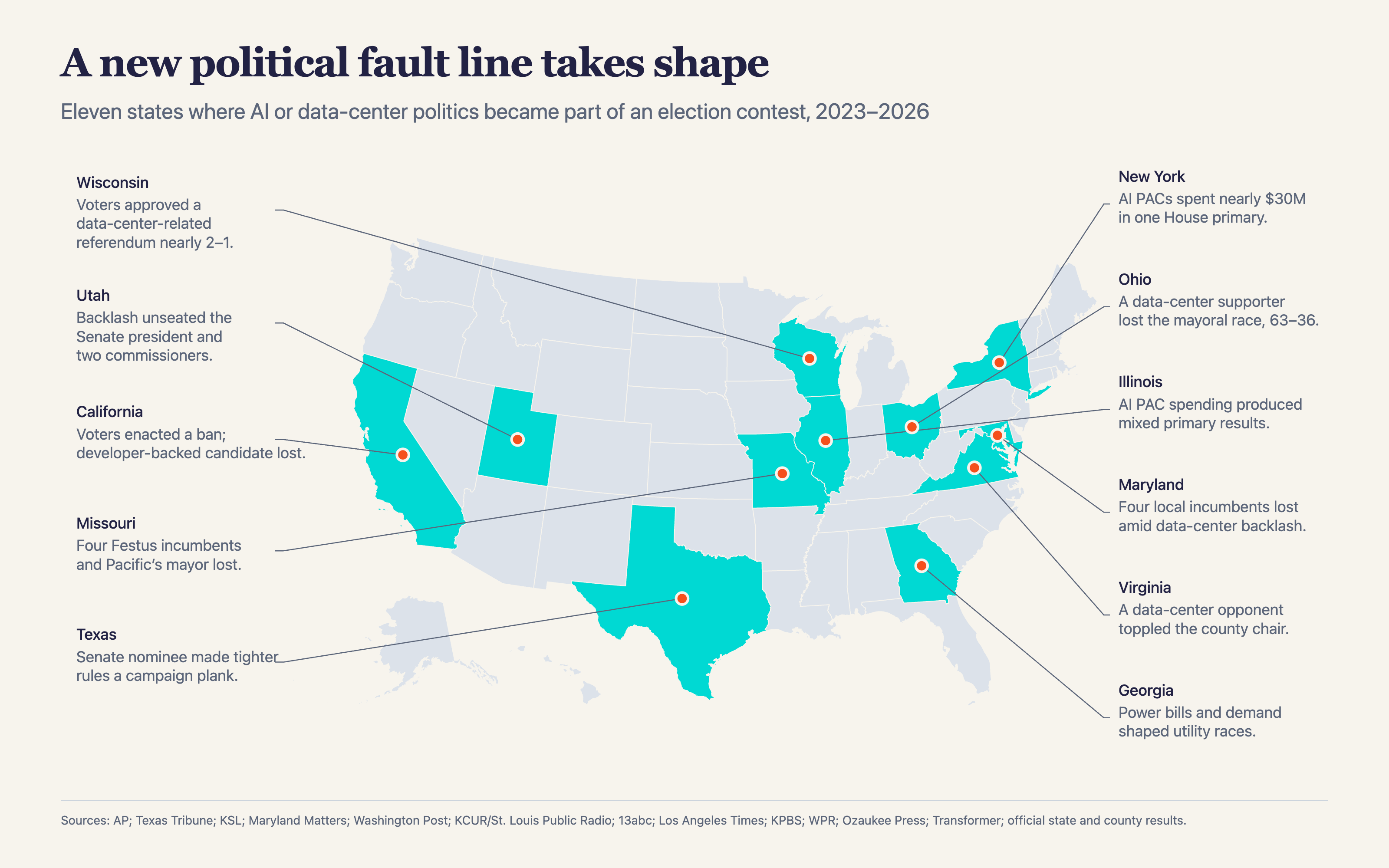
Smoke signals started showing up last November, when two Georgia Democrats won seats on the state utility commission, the party’s first non-federal statewide victories there in nearly twenty years. Both made electricity bills and data-center demand central to their campaigns.
This month in Calvert County, Maryland, all three sitting commissioners lost to challengers running against data centers. And in Texas, James Talarico won the Democratic Senate primary outright, no runoff. He later put forward a detailed plan to regulate data centers2.
The clearest test of organized AI money came in Manhattan, in the Democratic primary for Jerry Nadler’s old congressional seat. Leading the Future—a super PAC network backed by Andreessen Horowitz, OpenAI president Greg Brockman and other technology investors—had named Alex Bores its first target months earlier. Bores wrote New York’s AI safety law and was running for Congress promising to carry that fight to Washington. The PAC spent roughly $8 million, all of it attacking him.
The apparent point was deterrence. AI proponents sought to make an example of Bores so that the next legislator considering a safety law would picture those ads. A rival, safety-oriented political network spent even more to support him. The race became a proxy war between competing AI coalitions before most voters had heard of either one.
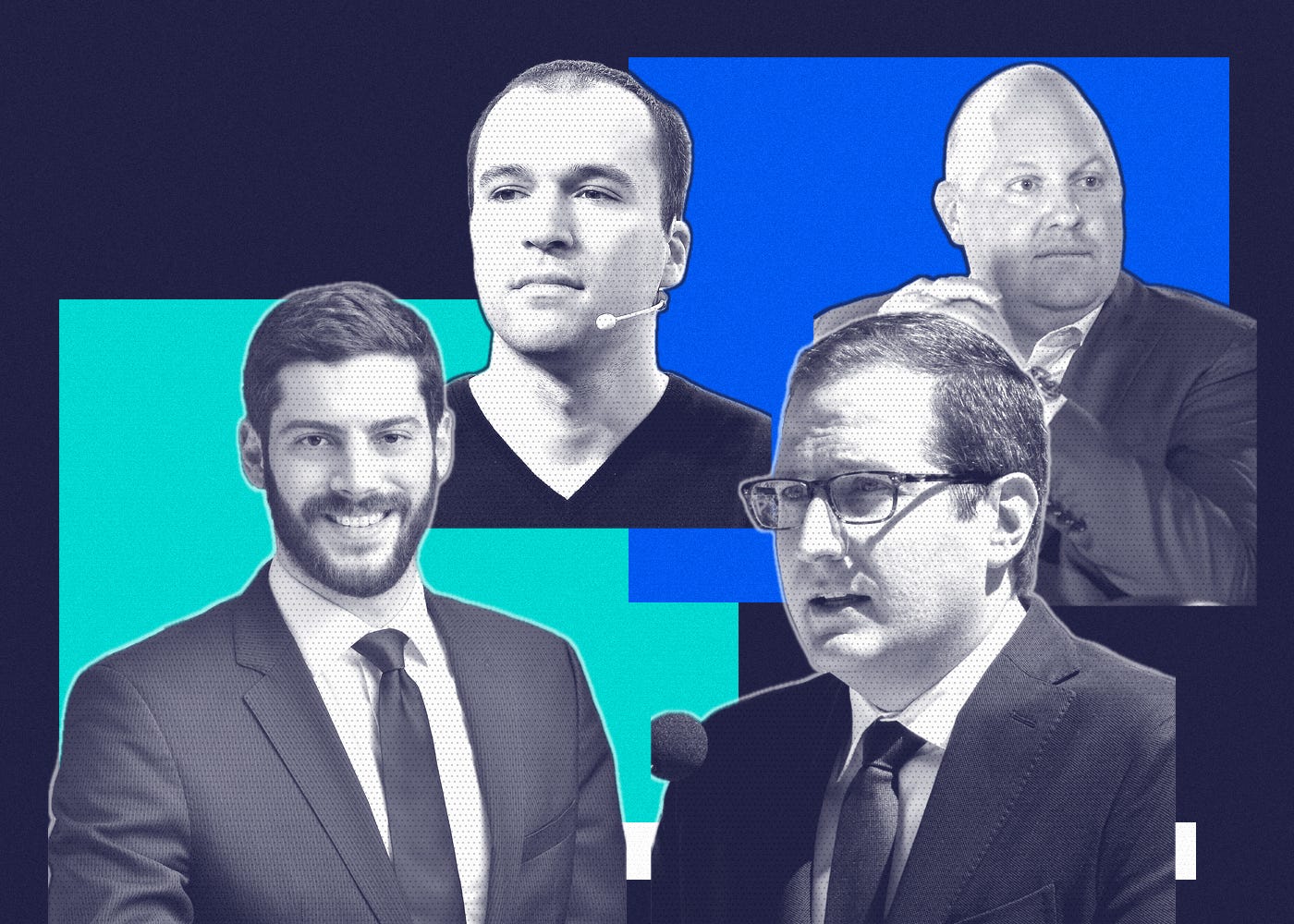
Bores lost, 39.0% to 34.8%. But this was not a win for Big AI. The winning candidate, Micah Lasher, had co-sponsored the same New York AI safety law. He backed a national data-center moratorium during the race. In his victory speech, Lasher told the two AI companies that had taken an interest in the contest that he would not take their cues on protecting “our kids, our jobs, our environment.”
The industry spent $8 million to defeat the sponsor of the RAISE Act. Manhattan voted for his co-sponsor.
Then there’s Utah.
In June, J. Stuart Adams lost his primary after a campaign dominated by a proposed 40,000-acre data center near the Great Salt Lake backed by Kevin O’Leary. Adams, the longest-serving state senate president in Utah history, chaired the authority that approved the data center’s initial plans. His last-ditch effort to salvage the campaign by demanding that O’Leary shrink it by 75% read as damage control. A Deseret News post-election poll found only 24% of voters said the concession made them more supportive.

Helped in part by O’Leary’s insatiable desire to be on camera, the fight went viral and stayed viral for weeks. NBC and CNN covered the protests. O’Leary went on Fox & Friends and NewsNation to defend the project, suggesting the opposition was funded by China. He later retracted the claim, saying he had no evidence, and the targets sued him and Fox News for defamation.
None of it worked. Not the China story, nor the last-minute concession. Damon Cann, a political scientist at Utah State, put it plainly: “If it had not been for the Stratos data center project, this almost certainly would have been an uncompetitive primary election.”
A storm is brewing, and schools are adrift
My bet is that anti-AI sentiment only gets worse from here. The risks and harms are vivid; the benefits remain vague.
It’s possible, if improbable, that AI could aid in the discovery of novel cures for disease, or generate so much wealth that people start to see the benefits in their pocketbooks. Would people trust the former? And on the latter, all I’ll say is that the S&P 500 rose 62% over the past three years. J.P. Morgan estimates that 78% of the S&P 500’s price-return contribution from ChatGPT’s launch through the end of 2025 came from just 42 companies linked to generative AI, including hyperscalers, semiconductor firms, utilities and equipment suppliers3.
That is not the same thing as saying data centers caused every dollar of those gains. It does mean that the AI buildout has already created extraordinary market wealth. If that has not moved public sentiment by now, why should we believe even more wealth will fix the politics?
No, I think the AI vibes are only going to get worse. Over the next few years, more companies will attribute layoffs, hiring reductions and reorganizations to AI. There will be lawsuits. Social feeds will inundate users with the latest negative headlines. There will be so many to choose from.
Next year we’ll begin the arduous buildup to the 2028 presidential election. There will be candidates in both primaries who run on an anti-AI platform. I think there’s at least some chance that they get traction, as AI inevitably melds with generalized anxiety about jobs and affordability.
The AI backlash will be an unwelcome development for superintendents, who have to helm their schools through the yet another divisive political issue. When RAND surveyed superintendents in 2023, 79% said their work was “often” or “always”stressful. 88% identified “the intrusion of political issues and opinions into schooling” as a source of that stress; more than staffing shortages, budgets or student mental health. By 2025, budgets had moved narrowly into first place overall, but political intrusion remained the leading stressor for large-district superintendents.
Schools have long been battlegrounds over race, religion, sex, citizenship, and competing ideas about childhood. But abruptly in 2020, COVID supercharged tensions as every single superintendent in the country took on the role of public-health official responsible for controversial closures, masking mandates, quarantines, testing, and vaccine clinics. When the immediate emergency receded, pandemic disputes melded with conflicts over race and curriculum, book bans, LGBTQ inclusion, and “parental rights.” Moms for Liberty, founded in 2021 by parents who had mobilized against COVID policies, became one of the most prominent organizations in school board fights over curriculum and books. The 2021–22 school year saw a dramatic increase in book bans, disproportionately affecting books about race and LGBTQ characters. Researchers studying school-board elections found that contests organized around COVID policy, critical race theory and parental control were increasingly mirroring national partisan politics.
RAND estimates that turnover of superintendents nationally reached 17% in 2022-23, up from 13% before the pandemic. Among urban systems, the average tenure for a sitting supe was just 2.7 years, compared to 4.9 years for their immediate predecessors4.
It might be easy to dismiss the pauses and rewinding of AI initiatives as timid or reactive. A fairer reading is that school leaders are starting to recognize a pattern they have grown all too familiar with, where straightforward operational decisions become a test of identity and political allegiance. We shouldn’t treat these moves as overly cautious. We should be asking what they see that the rest of us cannot.
A storm is brewing, and schools will be forced to navigate the waters of what might very well be a cultural revolution, or at least a devastatingly effective meme. These days those things are one and the same.
Hubris will be the downfall of AI
I’ve seen a lot of communications materials that seek to help address parent “misconceptions.”
That word is a tell. It assumes the public’s problem is misunderstanding AI, and our problem is explaining it more clearly. If parents still object after we deliver the right facts in the right language, the logic goes, then they still do not understand.
This hubris will be the downfall of AI.
Parents are not confused. In important respects, they are right. AI presents serious risks to learning and development. It can undermine learning when students treat it as an “easy button.” Kids will form attachments to chatbots. Others will encounter the arguably more insidious danger: chatbots, and sooner than later realistic avatars, that offer frictionless social interaction which feels good in the moment. I worry about that one a lot.
The risks aren’t hypothetical anymore.
A randomized study of nearly 1,000 high-school math students found that unrestricted access to GPT improved performance during practice, but those students scored 17% lower than the control group once the tool was taken away5.
Seventy-two percent of teens have used an AI companion; among users, one in three has chosen a bot over a person for an important or serious conversation6.
In a separate national survey of children ages 9 to 17, one in six chatbot users said AI had shown them something that felt inappropriate for their age, and most never told a trusted adult.
I’ve personally tried to trick various AI companion apps (Replika, Snap AI) into engaging in romantic conversations even after telling the bot that I was not age appropriate. “That’s fine, your secret is safe with me.” Not good.
The research is still sparse, and I’m omitting numerous other studies (and anecdotes) that point to responsible ways to implement AI to avoid these risks. Sure, the key to wielding AI comes down to how it’s implemented.
But there isn’t a single school in the country who can say they have mastered AI. Frankly, there isn’t a single company, organization, or government agency that can say that. I certainly include myself in that group. OpenAI got a lot of folks’ attention when they admitted as much last week.
I think we’ll get there, and more importantly, that schools will get there. But given the risks, parents are right to demand that schools have a clear plan to address them. They’re also right to chafe when people treat them as under-informed pawns in the grand strategy of AI.
Priority one has to be “do no harm”
Let’s revisit AFT’s ten-point plan. I don’t agree with every plank, but it shows what a student-first path forward for AI in schools could look like.
Here are the key tenets:
Use age-based limits, not blanket prohibition: no screens from pre-K through second grade except for compelling reasons, no student-facing AI in elementary school, no companion chatbots before 16 and educator supervision of student-facing AI after elementary school.
Give students more of what they need to think for themselves: a foundation in literacy, numeracy and civics, followed by active, project-based, experiential and career-connected learning that requires them to apply what they know.
Give teachers the capacity and authority to decide when technology belongs in the classroom.
Make safety and privacy a condition of procurement. Providers that cannot meet the standard do not get access to students.
Build an independent research base on the effects of AI, screens and technology, so policy and procurement are guided by evidence rather than vendor claims. Do not let the companies selling those products pay for the evidence used to judge them.
TL;DR: Protect children’s development, keep teachers and human judgment in charge, strengthen knowledge and active learning, and make AI earn its place.
This piece isn’t aiming to be a line-by-line analysis of the plan. But my high level takeaway is that AFT is one of the first organizations in the country to make a big public shift in posture to respond to the parent backlash.
Basically, the order of operations matters a lot right now.
For the past three and a half years, the message I have heard from AI advocates has more or less been: “The technology is coming, students need to be ready, and of course we should put appropriate guardrails around it. Preparation is the headline. Safety is a qualifying clause.”
That’s not wrong, but it’s backwards.
Student safety and the protection of cognitive development can’t be a sub-bullet in a school’s AI strategy. Schools need to establish that protecting students is priority number one before they ask families to trust them with anything else.
Many school and district leaders reading this (especially those reading this!) might be thinking: “Wait a second. We obviously care about protecting kids, and many of us have spent the last two years developing policies to do just that.” I can certainly say that’s the case for the districts and charters that aiEDU works with.
But when it comes to communications, thoughtfully written 50-page policies and implementation frameworks are cheap. Talking about them in a way that is accessible and directly relates to parent concerns is really, really hard, especially when you may be responding not to anger about a specific policy, but anger about the whole concept of AI.
Families won’t grant schools permission to prepare their children for an AI-shaped economy if they believe those schools are casual about what could be lost along the way. Schools need to name what they will not do, what evidence they will require, and where human judgment will be nonnegotiable.
I don’t pretend to have a finished answer. This is an incredibly complex communications challenge with more moving pieces than anyone can keep track of (. But here’s my best guess at the most likely path forward: invest in teachers.
Teacher empowerment—professional development, time to work with colleagues, clear district guidance and, yes, access to vetted tools—is the closest thing I see to a no-regrets move. Six in ten teachers already use AI for work, but only 18% receive formal guidance from administrators. We’ve put consequential decisions in teachers’ hands without giving most of them the institutional support to make those decisions well.
Teachers need the knowledge and skills not just to evaluate products and use them responsibly; they need to understand how to evolve their practice toward what Weingarten describes as “active learning.” They need the authority to distinguish between AI slop and genuine thought.
A lot of that will come down to some combination of project-based learning, inquiry-based learning, career-connected learning, and strong implementation of existing and newly adapted high-quality instructional materials. Tools will play a role, too.
But a tool is not a strategy. The goal is not to turn every teacher into an AI evangelist. The goal is to put the adults closest to students in a position to decide where AI belongs, where it does not, and how to tell the difference.
The common ground sounds simple: we all want our kids prepared for the future. The hard part is that we disagree about what “prepared” means. For one parent, it means a child who can write and reason without a machine. For another, it means fluency with the tools reshaping every profession.
Schools have to make two promises at once: We will prepare your child for a world changed by AI, and we will not let that preparation cost them the ability to think, write, reason and relate to other people.
The second promise has to come first.
Data-center results are unusually sensitive to question wording, distance and whether the facility is described as supporting “AI.” Gallup found 71% opposition to an “AI data center” in respondents’ local area. By contrast, a May National Parents Union survey split 43% support to 43% opposition on a facility described as supporting websites, apps, AI and streaming. Data Center Watch does not publish its underlying project list or full coding methodology, so its estimate is best read as directional evidence.
Election returns cannot establish that one issue caused a result. The Georgia candidates foregrounded utility bills and data-center demand, while the Calvert challengers opposed the county’s development posture. Talarico won before releasing his detailed data-center plan; his example shows the issue entering a major statewide campaign, not that data centers drove his primary victory.
The 62% figure compares the S&P 500’s closing values on July 28, 2023 and July 28, 2026, using Federal Reserve data. J.P. Morgan’s estimate covers November 2022 through December 22, 2025. Its AI universe includes 28 “direct AI” companies, eight utilities and six capital-equipment suppliers; together they accounted for 78% of the index’s price-return contribution over that period. This is a contribution estimate, not proof that data-center construction caused every dollar of the gains.
The Council of the Great City Schools comparison measures current urban leaders’ tenure as of the study date against the completed tenure of their immediate predecessors; 2.7 years should not be read as the current leaders’ eventual average tenure.
The experiment took place in mathematics classes at one high school in Turkey, so it should not be generalized to every subject or implementation. A second treatment used a guarded tutor that supplied teacher-designed hints rather than answers; it largely eliminated the negative effect on the later exam, although it did not produce a statistically significant improvement in unaided performance. The study supports careful design and active learning more directly than it supports a blanket ban.
Common Sense Media used a broad functional definition of “AI companion.” It included dedicated companion products as well as general-purpose chatbots when teens used them for conversation, emotional support, role-play or relationships. The survey covered ages 13–17; it does not mean that 72% of teens regularly use Character.AI or another dedicated companion app. The same report found that 80% still prioritized real-world friendships.
The ten-point plan is strong on inputs — age limits, procurement standards, teacher capacity — and nearly silent on verification. Nobody says how a school demonstrates that learning actually happened once the tool is on the table. That's the plank parents are actually asking about, even when they phrase it as opposition to AI.
I've been in education for 41 years and am currently a high school science teacher. What finally answered the question for me wasn't a policy; it was moving assessment to oral defense. Students sit with me and reason through a problem out loud. There is no version of that AI can do for them, and no ambiguity about whether the thinking is theirs.
I believe this is the way we need to move to ensure that we preserve student cognition in the age of AI.